Pages

Thursday, January 29, 2015

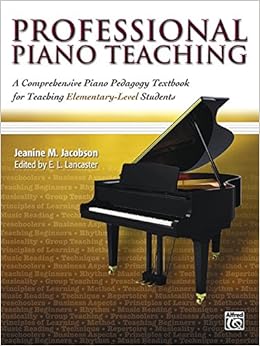
Professional Piano Teaching - by Jeanine M. Jacobson

Professional Piano Teaching: A Comprehensive Piano Pedagogy Textbook for Teaching Elementary-Level Students is a valuable resource that should be on the teacher's shelf. The book is quite readable and offers multiple examples for consideration. Carefully organized into clearly defined chapters, I found Jacobson's text to be extremely beneficial as it allowed me to focus on a single aspect of the complex process of piano teaching in each chapter. From her examination of method approaches to the discussions of teaching rhythm, technique, and sound development, Jacobson addresses our profession in such a way that clearly establishes her as an authority with lots of experience and expertise.

Perhaps most valuable for the new teacher (or those of us returning to the private student after a long sabbatical) are the chapters that conclude the book:  "The Business of Piano Teaching" and "Evaluation of Teaching." Over the years, I have found that the source of frustration for many teachers comes from not having clearly established policies that they feel comfortable implementing. Whether the issue relates to tuition, scheduling of lessons, or maintaining records, Jacobson offers sage advice in a way that makes the necessary task much more manageable. Additionally, Professional Piano Teaching reminds us of the importance of regular evaluation of our teaching as we pursue greater levels of excellence -- for the benefit of our students and the profession as a whole.

In conclusion, I wanted to share with you a few of the "nuggets" I found in Professional Piano Teaching. These words of wisdom have already impacted my personal teaching and I anticipate returning to the text repeatedly in the coming years.
  • "While isolated mistakes are common to all pianists, learned mistakes result when students do not understand or forget the necessary information. Once a student kinesthetically learns a piece incorrectly, it is very difficult for him/her to unlearn it. To eliminate frustration for both the teacher and the student, it is sometimes best to drop the piece and study the same concepts and skills in another piece." (p. 105)
  • "Pedaling is a listening skill, not a physical one, but a physical motion is needed to create the correct musical sound." (p. 170)
  • "Just as university professors organize lectures, ministers outline sermons, and public school teachers prepare plans that organize the day's activities, piano teachers should plan what to teach in each lesson and how it will be taught. . . A lesson plan brings focus to the lesson and assures learning, progress and accomplishment. Teachers should not be afraid to alter the lesson plan when the student has practiced more or less than expected or has trouble with the assignment. The lesson plan provides structure so the teacher can confidently provide a valuable learning experience, regardless of the variables." (p. 206-207)
I highly recommend Professional Piano Teaching regardless of how long you have been in the profession. I am confident that Jacobson will inspire and challenge you. What books have you found to be most beneficial to your growth as a teacher? I'd love to have your recommendations to add to my personal reading list.

Thursday, January 22, 2015

Why Fingering Matters

My adult piano students struggle with using secure fingering when playing. Whether I am dealing with a hobbyist or college music major, the question is always the same....why does it matter which finger I use? Isn't the goal to simply play the right notes?

Such questions display a lack of understanding about the musical benefits of good technique -- including, but not limited to, fingering patterns. In her wonderful book Professional Piano Teaching: A Comprehensive Piano Pedagogy Textbook for Teaching Elementary-Level Students, Jeanine M. Jacobson sums up the importance of fingering in the following passage:
Appropriate fingering makes playing more comfortable and solves technical problems while reducing tension. When students do not observe the written fingerings, they often play pieces with different fingerings every time. This results in several mental etchings of the same musical material, with the mind choosing, at random, a different fingering for each subsequent encounter. Because accurate playing of the piano is a physical habit and no consistent fingering habit has been established, learning of the piece is delayed. Furthermore, poor fingering habits make it more difficult to focus on musical aspects of performance. (Jacobson, Professional Piano Teaching, 169)
In addition to Jacobson's eloquently worded defense of fingering, I would add the following benefits of focusing on secure fingering patterns.
  • Good fingering enhances melodic phrasing.
  • The study of fingering patterns ensures the technical development of the entire hand - especially the use of fingers 4 and 5 - and does not rely solely on the more dominant fingers.
  • Carefully thought out fingering allows the performer to easily transition between sections of the music.
  • Secure fingering often allows strong fingers (i.e. dominant fingers) to arrive on strong beats, producing a fuller sound while eliminating technical challenges.
Quite simply - GOOD FINGERING MATTERS!

Thursday, January 15, 2015

Bach Chorales in Piano Instruction

I have found that many young pianists struggle to play four-voice harmonizations. Because of the many benefits that come from studying them, I require college students enrolled in class piano to play both traditional hymns and Bach chorales. Here are a few of the benefits that comes from this area of study:
  • Awareness of voice leading. Few composers understood counterpoint and voice leading better than Bach. By playing the chorales, pianists take the principles they have learned in theory and apply them at the keyboard.
  • Re-enforcement of harmonic progressions. Chorales clearly establish traditional dominant-tonic relationships as well as others that will aid the student as they develop their own skills to harmonize melody lines.
  • Develops aural skills. Chorale playing requires the pianist to be aware of multiple lines at the same time, ensuring that each voice is shaped independently. This attention to various voices increases the student's aural skills.
  • Emphasizes the importance of thoughtful fingering patterns. Bach's compositions require careful planning in order to musically navigate the multi-voiced passages. Students find themselves exploring alternate fingerings, finger substitutions, as well as dividing inner voices between the hands as they play these technically demanding works.
  • Prepare students for choral accompanying assignments. It seems that one of the most demanding duties of any musician working in an educational setting is providing piano support for voices during choral rehearsals. Many times, the vocal parts can be more technically challenging for the pianist than the actual accompaniment. Bach chorales and their emphasis on voice leading allow the student pianist to develop skills that will be beneficial in similar scenarios.

Thursday, January 8, 2015

The Importance of Great Beginnings in Music Education

Beginnings are vitally important. A great novel often grabs the reader's attention with the opening sentence. Hollywood blockbusters ensure their success through lavishly staged opening segments. Educators emphasize the importance of the first years of life to a child's intellectual development. It should come as no surprise, therefore, that a solid early foundation in musical fundamentals is essential to a student's long term success.

The start of the new year is the perfect time for parents and teachers to evaluate the progress their beginning piano student has made thus far in their instruction. For many, the greatest problem is not determining whether or not progress is being made, but determining the cause when slow progress is observed. In my own teaching, I have discovered a few recurring issues that appear to contribute to the situation. I have listed them here in an order that I find helpful in discovering the underlying issue.

  • Unrealistic expectations. Because beginning piano students often excel in other pursuits, it is sometimes difficult for parents to realize that progress in music may come at a significantly slower pace. Like the acquisition of a new language, it takes time to become fluent in music. While it is not likely that your student is a prodigy like Mozart, discernible progress should be expected at a regular and steady pace. A child may struggle for a few weeks to grasp an elementary concept; this should not cause extreme concern. If the child continues to struggle with the same issue for more than three or four weeks with no discernible progress (assuming lessons are occurring regularly), it is advisable to look for a deeper cause of the stalemate.
  • Insufficient practice. "There are no shortcuts." I find this is often the cause of limited musical advancement that is overlooked by both parents and students. Regardless of how talented a pianist is, there is no substitute for practice. Consistent practice time at the piano is necessary to master new skills and to develop musicality. What should be practiced? Practicing is much more than just playing through the entirety of your repertoire. For starters, daily attention should be given to correcting errors, building technical skills, navigating challenging passages and shaping the melodic line. Instruction on how to practice and what to practice should be discussed in the piano lesson. How much practice is necessary? That's a common question that cannot be easily answered across the board. As a general rule, most beginning students should expect to invest at least 20 minutes in diligent practice each day. Rather than strictly focusing on the amount of time, however, I encourage students to use improvement as their motivation for daily practice.
  • Lack of parent-teacher communication. An open line of communication between the adults involved in the student's musical development is always extremely beneficial. The parent can provide insight into what is happening between lessons while also sharing areas of student frustration and confusion. The teacher that values parental input will be certain to provide information about supplemental resources (e.g. flash cards, technology aids, and additional music) that can aid the student's development. The most common method of parent-teacher communication comes in the form of a lesson notebook; with the increased use of technology in music instruction, electronic methods of communication between the home and studio are becoming more common, too. Whatever the method, the home communication allows the teacher to clearly state the week's goals while sharing additional information with parents. If a formal system of weekly communication has not already been established in the lesson, the parent should feel free to inquire about its development.
  • Misunderstood concepts. When a child is facing a road block in his musical development, a misunderstanding of an essential fact may be the root problem. A professional teacher should identify such circumstances quickly and develop a plan for correcting the error. If a parent observes a season of little progress, a gentle, non-threatening conversation with the student might reveal the misunderstanding that can then be communicated to the instructor. If the instructor becomes defensive when the issue is brought to their attention, it may be a signal that a more harmful problem exists.
  • Insufficient instruction. Once we have eliminated the above issues as the source of minimal student development, it then becomes necessary to examine the quality of instruction. Not everyone who can play an instrument is qualified to teach. Questions about professional training and teaching experience can often be obtained from a studio website or casual conversation with the teacher. Parents may also seek out information about the teacher's reputation in the community. If the instruction is found to be inferior, it is imperative to the student's development that a thoroughly qualified teacher be found as quickly as possible.
    • As a further note on the topic of instruction, it is also important to realize that no teacher is best in every situation. A pedagogue that specializes in adult beginners might not be the best fit for an adolescent student. A piano teacher with limited experience might not be a good fit for the student who is interested in the competitive circuit. Students with special needs will most greatly benefit from teachers who have specialized training and experience with similar students. Each situation is unique. The parent's best tools in making a decision about their child's study is information and personal intuition.
  • Absence of talent. As a last possibility, we must state that in extremely rare circumstances, a student may simply not possess any musical talent. I have never encountered a student who could not achieve some level of musical advancement through private instruction. Before allowing your student to be lumped into this "no hope" category, I recommend speaking frankly with all music teachers the student has encountered (school and private teachers, past and present) as well as other respected music professionals. The last thing that should happen is to have a child's musical interests crushed because of a poor assessment of their musical potential.

Thursday, August 21, 2014

Instrument Maintenance

As instrumentalists, we are constantly aware of the steps we need to take to maintain our instruments. New strings need to be installed. Pads need to be replaced. Sadly, student musicians sometimes neglect the maintenance due to the expense involved. I am convinced that another type of maintenance is equally important for our success: the personal maintenance of our bodies.

The musician's physical body is integral to the production of good sound. We must ensure our physical health through proper nutrition, exercise, and adequate rest. Additionally, performing artists may find that support devices such as wrist braces allow the body to heal while preventing further irritation and damage from unnatural movements. Massage therapy can also be helpful in relaxing muscles in order to allow them to function properly.

Our mental, spiritual, and emotional health cannot be overlooked either. In order to be a healthy musician, we must seek out methods to release stress. Some find activities such as reading, hiking, or crossword puzzles helpful in calming the mind's activity. I enjoy using prayer journals and meditation to clear my thoughts while connecting me to the strength I find in my own spiritual pursuits. Regular conferences with a trusted mentor or professional counselor can also be useful in dealing with issues related to our mental health. Regardless of the methods you employ, the important thing is to make sure that you are carefully maintaining the most important parts of your instrument -- your body, mind, spirit, and emotions.

Thursday, July 31, 2014

Sea-Snatch and The Praises of God: A Look at Two of Samuel Barber's Hermit Songs

The summer is winding down and it's time to get to work on some pieces that are scheduled to be performed in the fall. Instead of just learning the notes and keeping all of my thoughts to myself, I thought it would be fun to share what I'm learning about the pieces and any practice tips I discover along the way.

First, we need to know a little about the Hermit Songs themselves. This cycle of 10 songs was composed in 1953 by Barber and was premiered that same year by Leontyne Price with the composer at the piano.

Sea-Snatch is the 6th song in the cycle and features an ostinato bass line in the piano that serves as the unifying figure of the work. The surging accompaniment is mostly in alternating rhythmic patterns of five and four. Melodically, the bass line continually keeps the opening vocal line before us.

One of the technical challenges the pianist faces is exacerbated by the tendency of many singers and pianists to rush the perpetual eighth notes just as the difficult parallel fourths appear in measures 7. A similar passage returns at the song's conclusion (beginning in measure 27). Let's look at the first of these passages. While the musical structure is one continuous legato line, the phrase is technically divided into groups of two; the successive F's in the fourths can easily be played with the index finger, providing a nice anchor for the entire passage.

The interlude between the verses is the most active passage of the short song. Upon listening to various recordings -- including Barber accompanying Price -- it is clear that the passage is demanding and rarely played cleanly. Some pianists recommend dropping some of the octaves for single notes instead. Others opt to simplify the right hand.  At this point, I am not using either of these options. To aid in fitting things together, I continued using block chords as found on the downbeat of measure 20 before slowly breaking the chords into the two eighth note figure.

The most helpful discovery came from listening to the Barber/Price recording. Barber inserts two rather sizable lifts, interrupting the accompaniment's perpetual motion.  These breaks occur at the end of measure 9 and again just before the final two chords in the lowest register of the piano. Additionally, the composer took a bit of time in measure 19 before launching into the massive interlude.

Once the notes are in hand, settling on a tempo that is comfortable for both pianist and singer will be essential. I am certain there will be a compromise made as we prepare for recital.

The 9th piece in the cycle is The Praises of God and poses some challenges for my relatively small hands. The piece is largely built on broken tenths; to further complicate things, the metric organization appears much more complex than what is commonly found in Barber's other songs. What I found most helpful was to begin with the B major section in the middle of the song first. This section begins firmly in 6/8 and remains in that meter through the end of the vocal line. Next, I turned my attention to the postlude and acquainted myself with the broken 10ths of the accompaniment. Most of the tenths move in third relationships (but beware of the fifth movement in measure 28 though!)

The most challenging portion of the song for me was the transition into the B major section (measures 10-12). I'm not sure if this is due to the dastardly annoying page turn separating measure 12 from the others or the inclusion of a measure of 3/8 before shifting back to 5/8. Regardless of the reason, this is the passage with which I will be spending a lot of time in the weeks ahead.

For now, it's time to head back to the practice room and continue working on these beautiful songs at slow tempi before adding the vocal line to the ensemble!

Thursday, July 17, 2014

Piano Festival Adjudication

I've been following the posts over at Piano Teacher Central on Facebook (an amazing network and wealth of knowledge if you haven't discovered it yet) and was struck by one post in particular that got me thinking. A teacher had just received comments from a festival her students had participated in recently. As luck would have it, the majority of her highly motivated students had one adjudicator; those who were a little more lax in their preparation had a different judge. When the scores were compared, the better students received scores roughly 5% lower than their less-prepared counterparts because the commentators had different standards for their scores. What's a teacher to do?

My first thought is that this is one of the difficulties (dare I say, failures?) of many piano festivals. When multiple adjudicators are involved, a common standard is needed to ensure fairness across the board. While many of the qualities being judged are subjective and a matter of personal taste, there are some aspects of the music on which we can all agree. I experienced this discrepancy myself as an adjudicator. While listening to students, I was most concerned with their musicality and overall communication. My esteemed colleague was solely addressing the technical aspects of the music. In reality, the two characteristics cannot be separated; it's only when we place greater emphasis on one or the other that scores can become skewed.

When adjudicating, I think it's important to encourage the student in their efforts. Commend them for what's going right. However, we also have a responsibility to offer constructive criticism that will help the student continue to develop. It's a balancing act for sure, and very challenging when we find ourselves making comments in a short amount of time in order to keep the festival on schedule.

Students need to know that judges are offering their opinions . . .and that we may not always agree about subjective aspects of music. In my own studio, I try to prepare students for this aspect of music by offering opportunities to respond to the music they've heard. Sometimes we make comments about performances heard in group classes. We also listen to excerpts in lessons followed by a student critique. I always ask students to comment on their own playing before I begin talking. These exercises allow the student to see that everyone has an opinion about the performance. While we don't always see things the same way, it does give the student a little taste of the hard job of offering feedback while preparing them to think critically about their own playing.

When we teach our students to focus on the experience of performing rather than the scores they receive, we begin to develop artists that are confident in their abilities in spite of less than favorable reviews or harsh criticism. Their focus becomes their personal love of making music and effectively communicating with the audience. And THAT'S the ultimate prize!