Pages

Showing posts with label book review. Show all posts

Thursday, January 29, 2015

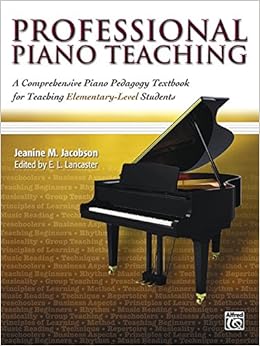
Professional Piano Teaching - by Jeanine M. Jacobson

Professional Piano Teaching: A Comprehensive Piano Pedagogy Textbook for Teaching Elementary-Level Students is a valuable resource that should be on the teacher's shelf. The book is quite readable and offers multiple examples for consideration. Carefully organized into clearly defined chapters, I found Jacobson's text to be extremely beneficial as it allowed me to focus on a single aspect of the complex process of piano teaching in each chapter. From her examination of method approaches to the discussions of teaching rhythm, technique, and sound development, Jacobson addresses our profession in such a way that clearly establishes her as an authority with lots of experience and expertise.

Perhaps most valuable for the new teacher (or those of us returning to the private student after a long sabbatical) are the chapters that conclude the book:  "The Business of Piano Teaching" and "Evaluation of Teaching." Over the years, I have found that the source of frustration for many teachers comes from not having clearly established policies that they feel comfortable implementing. Whether the issue relates to tuition, scheduling of lessons, or maintaining records, Jacobson offers sage advice in a way that makes the necessary task much more manageable. Additionally, Professional Piano Teaching reminds us of the importance of regular evaluation of our teaching as we pursue greater levels of excellence -- for the benefit of our students and the profession as a whole.

In conclusion, I wanted to share with you a few of the "nuggets" I found in Professional Piano Teaching. These words of wisdom have already impacted my personal teaching and I anticipate returning to the text repeatedly in the coming years.
  • "While isolated mistakes are common to all pianists, learned mistakes result when students do not understand or forget the necessary information. Once a student kinesthetically learns a piece incorrectly, it is very difficult for him/her to unlearn it. To eliminate frustration for both the teacher and the student, it is sometimes best to drop the piece and study the same concepts and skills in another piece." (p. 105)
  • "Pedaling is a listening skill, not a physical one, but a physical motion is needed to create the correct musical sound." (p. 170)
  • "Just as university professors organize lectures, ministers outline sermons, and public school teachers prepare plans that organize the day's activities, piano teachers should plan what to teach in each lesson and how it will be taught. . . A lesson plan brings focus to the lesson and assures learning, progress and accomplishment. Teachers should not be afraid to alter the lesson plan when the student has practiced more or less than expected or has trouble with the assignment. The lesson plan provides structure so the teacher can confidently provide a valuable learning experience, regardless of the variables." (p. 206-207)
I highly recommend Professional Piano Teaching regardless of how long you have been in the profession. I am confident that Jacobson will inspire and challenge you. What books have you found to be most beneficial to your growth as a teacher? I'd love to have your recommendations to add to my personal reading list.

Thursday, July 18, 2013

Book Review: The Mastery of Music

If you've been involved in music for very long, I'm sure that you are familiar with The Inner Game of Music by Barry Green and Timothy Gallwey. Earlier this year, I stumbled across another work by Green that I wasn't familiar with --  The Mastery of Music: Ten Pathways to True Artistry. The title caught my attention immediately; sadly the book didn't see the light of day under mounds of music and paperwork that demanded my attention.

This week I saw the green cover again and took the time to dive in. What a wonderful read! Green devotes an entire chapter to each of the ten pathways he identifies as necessary for artistry.  The pathways are communication, courage, discipline, fun, passion, tolerance, concentration, confidence, creativity, ego and humility. To assist in the mental organization of the book, Green associates each characteristic with an instrument that is stereotypically associated with the quality. Who can argue with the assertion that trumpet players have loads of confidence? I especially found the humor in discussing tolerance from the perspective of the musicians in the middle -- the violas as well as music managers.

Green's prose is easy going and tinged with memorable phrases. To add to the quality writing, Green includes anecdotes and interviews from leading instrumentalists. Their insight into the importance of the  specific characteristic and suggestions on strengthening that quality in your own life are definitely worth consideration by all musicians. I am certain that I will return to various chapters of the book again and again in the years to come.

Two discussions in particular spoke to me as I read The Mastery of Music for the first time. First was the chapter on courage.  Dale Clevenger, principle horn player with the Chicago Symphony, had this to say about the courage of musicians:
I don't think of what I do as particularly courageous -- but I do believe that what we do is deeply important: we affect the souls of those our music touches. To me, playing music is a very high calling: it is a responsibility, and a sacred trust. Making music may sometimes be difficult and sometimes fun -- but for me, at least, it is first, last, and always an honor and a joy. (Green, The Mastery of Music, p. 65)
What a beautiful expression of why we make music on a regular basis! I immediately found myself ready to rehearse with new vigor after reading that passage.

The other discussion that resonated with my soul was the chapter devoted to creativity. This pathway is referred to as the journey into the soul. In his examination of composers and improvising musicians, Green included several gems that I find it hard to select just one to highlight. So I'll share a few of my favorite statements.

Creativity breeds creativity just as humor breeds humor.  (p. 239)
Most people don't enjoy eating the same food, viewing the same movie, or wearing the same clothes every day. Creativity seems to be inspired by a human desire for variety, uniqueness, and personal expression. While the creative process is always going on within the souls of everyone, sometimes we need a specific inspiration to bring these impulses to an artistic form. (p. 244)
[from an interview with Fred Hersch, jazz pianist] Picasso said that if you want to create art, you have to make a mess. You have to take the time to experiment. You can't get side-tracked by perfection issues if you want to be a great artist. You have to take chances -- and a certain percentage of them are not going to bake. But over time, your batting average will get higher.
I can't offer enough high praise for this inspiring book. Get your hands on a copy and let yourself begin to travel each of the pathways to artistry with new vision.

The Mastery of Music: Ten Pathways to True Artistry was published by Broadway Books in 2003. 
 

Thursday, July 11, 2013

Review of "Music in the 18th Century"

Since summer tends to be a slightly slower pace for me, I try to catch up on some of my academic reading. A quick search on the Barnes and Noble website revealed that a new Norton History series entitled Western Music in Context has been edited by Walter Frisch.  Since the first volume on medieval music wasn't available, I decided to begin with John Rice's volume on Music in the Eighteenth Century.

I found Rice's work informative, insightful, and unique in its approach to the topic. I was surprised to find that the luminary composers that are normally associated with the era -- Haydn, Mozart, and Beethoven -- did not dominate the volume. I found it refreshing to explore other composers in the light of the century's history and developments.

Possibly the greatest attribute of Music in the Eighteenth Century was its arrangement. Rather than telling the musical story from a strictly chronological point of view, the music's development was traced geographically as well as historically. It was fascinating to explore Paris in light of the French Revolution, St. Petersburg during the reign of Catherine the Great, and London in the 1790s instead of just focusing in on the city of Vienna. Rice's prose is extremely well-written and easy to follow. The book seamlessly weaves historical events and political developments with composers and their output. (Additionally, a companion anthology which I did not purchase is also available to allow further study of the era's music.)

Every text has a weakness. In my opinion, Rice's explanation and use of theoretical terms related to the "schemata" identified by theorist Robert Gjerdingen in 2007 was the potentially fatal flaw of the work. I found the inclusion of the schemata explanation to negatively interrupt the flow of the book. I further questioned their inclusion and the validity of their use (a question Rice raises at the end of the chapter). Without the theoretical discussions, I believe the text and accompanying anthology could be a valuable resource in academic settings in the future.

I plan to continue investigating the Western Music in Context series. I appreciate the series' readability while maintaining a high level of scholarship. I'm looking forward to diving into the volume devoted to the 20th and 21st centuries in the coming months.

Wednesday, July 27, 2011

Book Review: Why Mahler?


Recently I came to realize that while I know quite a bit about musical trends and movements from a historical perspective, my knowledge of the biographies of many of the major composers is less than complete.  As part of my personal goals, I am beginning to add biographies to my reading list.  The first biography that I completed was Norman Lebrecht’s fascinating book Why Mahler?  How One Man and Ten Symphonies Changed Our World.

Lebrecht paints a stunning portrait of a musical genius who feels as though he belongs nowhere.  He is not accepted by his Viennese home, finds no relief in Judaism, and is never comfortable in the United States.  Additionally, his works are often overlooked and considered inferior by many of the critics of the day. 

Lebrecht is also careful to present the love between Gustav and Alma with honesty and clarity.  Alma’s penchant for exaggeration – or blatantly lying – to present her life in a favorable light is addressed on numerous accounts.  Their mythological love is handled with dignity and simple honesty.

One of my favorite scenes comes at the end of the biography.  Returning to Europe on board the SS Amerika, Alma is putting the couple’s daughter Anna to bed.  Mahler knows that he is going to die soon, so “he gives final orders to Anna Moll [a family friend].   He wants to be buried beside his daughter Maria in the Grinzing cemetery, without fuss, and just ‘Mahler’ on his headstone.  ‘Anyone who comes to look for me will know who I was and the rest don’t need to know.’” (Lebrecht, 194)  This Devil-may-care attitude is indicative of Mahler’s life and career.  Such a fitting end for an interesting and passionate man.

Why Mahler? is written in three major parts.  Section I deals with some frequently asked questions about the man and his music before launching into a thorough biography in Section II.  The final section examines issues of interpretation and will be a valuable resource to any student of Mahler’s orchestral works. 

Lebrecht explains the need for this final section by telling us about Mahler’s views as a composer and conductor.
 
Mahler was, on the one hand, a precisionist who tried to leave nothing to chance and, on the other, a dreamer in pursuit of an unattainable perfection.  Recognizing these limitations, he licensed conductors to use their discretion when performing his works.  “If after my death something doesn’t sound right,” he told Otto Klemperer, “then change it.  You have not only the right but the duty to do so.” (Lebrecht, 212)

Lebrecht then launches into a detailed analysis of major recordings of each of the orchestral works, citing successes, failures, and missteps by leading conductors.  Lebrecht is quite thorough and provides both historical and contemporary examples.  While this section is not a page-turner like the biography, the extensiveness and breadth of the discussion makes it an enormously valuable resource.

Wonderfully written in a mostly flowing prose style, Why Mahler? is an excellent book to add to any music historian’s and performer’s library.  Whether you are looking for a simple introduction to the life of this composer or intimate details, this book will certainly have what you are looking for.