Pages

Showing posts with label professional development. Show all posts

Thursday, March 12, 2015

Piano Teacher Institute

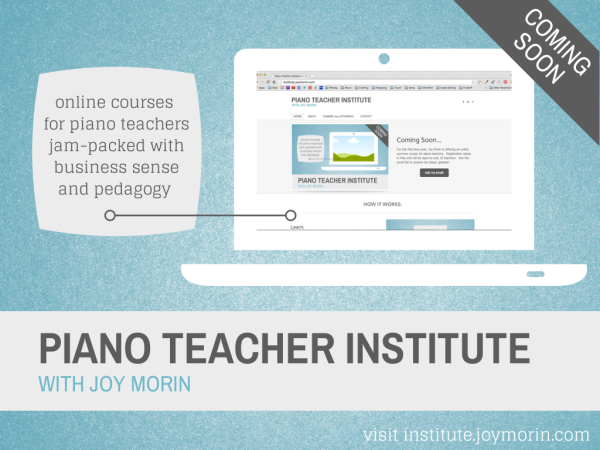
I fervently believe that it is essential that musicians seek out opportunities to improve their skills as performers and teachers. Professional development can come in many forms: attending conferences and seminars, reading recently published books and journals on the topic, as well as participating in web-based events. As 2015 got started and I found myself returning to private piano teaching, I decided to take advantage of the opportunity to enroll in Joy Morin's online Piano Teacher Institute.

PTI is a 6-week course that addressed topics from the business matters related to the piano studio, to selecting student repertoire, and conducting the initial lesson with a new student. In addition to weekly reading assignments transmitted as PDF files, the course also included multiple writing assignments that would generate feedback from Joy and a weekly video chat with other students enrolled in the course.

Before I begin my personal reflection on the Piano Teacher Institute, I need to be very transparent. I opted to participate in the winter session because it appeared that I would have much more time to devote to the class. As soon as PTI began, my schedule changed sharply and did not permit me to be as active as I had hoped. Having said that, I still found Joy's course to be informative and very beneficial.

In my personal opinion, the PDFs that accompany the course are worth the price of enrollment. They present material in an approachable manner that is well-reasoned and carefully researched. I also appreciated the "For Further Reading" lists that are found at the end of each chapter; these lists have contributed to my professional reading list as I continue to explore the area of piano pedagogy. Because the files are PDFs, downloading them was very easy and ensures that I will be able to consult them again in the future. My only complaint about the readings provided was that they did contain several typographical errors -- mainly related to spelling and grammar -- that seemed to slightly diminish their professionalism, although they did not significantly impact the message that Morin was conveying. (I know that PTI is a relatively new offering for Joy and anticipate that the documents will be revised in the near future as she continues to make improvements and adjustments.)

The weekly writing assignments offered opportunities to think about a wide range of topics. Some focused on the theory of pedagogy while others allowed students to reflect on how the concepts discussed were reflected in their own studio and teaching. With at least 6 assignments of varying lengths each week, I found them to be very time consuming and was not able to complete any of them. I would have liked to have had the opportunity to receive feedback from Joy, but the magnitude of the assignments as well as my personal schedule created an overwhelming situation that I couldn't get past. However, in the weeks since completing PTI, I have found myself completing several of the suggested writing tasks and have seen the benefit of the exercises in my personal teaching.

The weekly video chats were amazing! Housed in Google groups, the video conferences were easy to access. Since it is expected that students may have a conflict with the scheduled chats, videos are uploaded for later viewing as well. The conferences are conducted in an open-discussion format. Joy begins the discussion with topics in the week's lessons and the conversation follows participant interests. Occasionally, a conference can be dominated by an out-spoken participant (or by the fact that some of the others are too shy to jump in); Joy was quick to gently bring others into the discussion without putting anyone on the spot. Sometimes I think I would have liked a few more directly posed questions -- "Kennith, what are your thoughts about....." -- especially in the early weeks to help pull some of the more shy students into the discussion and assist with the creation of our online community.

I highly recommend piano teachers consider enrolling in the Piano Teacher Institute. Whether you are a newbie to the teaching profession or an experienced pedagogue, I am confident that you will be energized, challenged, and encouraged by the content as well as by Joy's gentle personality. If possible, participate in a session of the course when you have a little more time to devote to it. I would estimate that in order to really glean all of the information contained here (and to complete the written assignments adequately), a teacher would want to allow at least 10-15 hours weekly to interact with the material.

To learn more about PTI's upcoming schedule and tuition costs, visit institute.joymorin.com. While you are there, make sure to check out Joy's piano blog, Color in My Piano.

Thursday, June 19, 2014

Recruiting Students

In a recent conversation with a colleague, the topic of student recruitment was raised. As we talked about the necessity and challenges of recruiting quality students to our college programs, I began to realize that the challenge is much the same for a private teacher as it is for the college music department. As I've continued to reflect on this topic, these are a few key factors that came to my mind.

  • Visibility is essential. In order to draw students, they must know where we are and what we have to offer. A teacher or music department that does not have an active performing and/or lecturing schedule is certain to fall away into obscurity. What does this look like? In addition to recital appearances, the teacher should also actively participate in adjudication and master classes as a clinician whenever possible. Visibility is further enhanced through a powerful presence on social media outlets. Hosting various workshops, festivals, and group instruction opportunities can also put a music department on the radar of potential students.
  • Know your limitations! No teacher is strong in every area of musical instruction. Know where your strengths lie and focus on recruiting those students. A small music department with strengths in musical theater, accompanying, and classical performance should not focus their recruitment efforts on jazz players. The students will be disappointed, the faculty will not shine, and a negative reputation for the institution will result. Focus on what you know best and do that with excellence!
  • Don't ignore the community's impact. Some of the best marketing around comes by word of mouth. Look for opportunities to involve the local community in your music making and reap the benefit of positive feelings about your program. Music departments might host a community choir or theater group. To reach families with young children, a school could offer quality musical instruction at a reasonable price through a community music school. The private teacher can be an active participant in their local chapter of MTNA and participate in local amateur activities while establishing themselves as a gifted professional. Additionally, the private teacher might provide short seminars through a local arts council. Interactions of this type can often lead to greater involvement in the future.
  • Foster a sense of stability. If a private teacher wants to recruit a number of new students, families must sense that you are investing in the long-term development of the students. You have to put down some roots in the community. Music departments must make strides to eliminate constant faculty turn over. What serious student in their right mind would plan to attend a school where there is a high probability that they will have two or three different master teachers over the course of their collegiate career? That's the Catch-22 in higher education. Many small schools want to develop greater draw and retention among music majors, but they are unwilling to invest the finances to permit qualified, passionate faculty to make a long-term investment in the department necessary to build the program.
What other actions that lead to successful student recruitment and retention come to your mind? What has been most effective in your personal studio or college music department? What challenges have you faced? I'd love to hear about it all in the comments below.

Thursday, December 26, 2013

Goal Setting

As another year comes  to a close, people everywhere are beginning to set goals for 2014. Music educators are not immune to this process. Many of us are reflecting on the progress our students made in 2013 and considering the next goal to present to them. In all of the planning, it becomes easy to overlook the opportunity to set new goals for the most important musician in our studio:  OURSELVES! Few of us pursuing careers in music hold a single job title, so it may be important to set an obtainable (and valuable) goal for each part of our musical life.

I tend to devote the smallest amount of time to my personal development as a soloist. My piano students are all beginners and intermediates. I rarely have an opportunity to perform major solo works. Over the years, I have moved away from solo performance because I have not developed the ability to play securely from memory. Recognizing this weakness in my skill set has led to my first goal of 2014:  I will memorize two major works for solo piano. That's not an overwhelming project, I know. Because of my time limitations, I decided to keep the number small so I have plenty of time to explore methods of memorizing and try to discover what works best for me.  The two pieces I have chosen are Beethoven's Sonata, Op. 2, No. 1 and Chopin's Scherzo in Bb minor, Op. 31.

My major area of performance is as a collaborator with vocalist. My bread and butter comes from knowing the major song repertoire. I feel secure in my knowledge of the German, Italian, and English rep; French songs are another story. I haven't mapped out a plan yet, but my goal is to become more familiar with the songs of Debussy, Ravel, Faure, Poulenc, and Hahn. At this point, I anticipate intentionally listening to the songs and reading/learning through the complete works. It's a goal; now I simply have to solidify a plan and get to work.

Presenting informative and enjoyable lectures can be a challenge. The situation becomes more difficult when the audience is composed of college students you are desperately trying to engage with the material. Encouraging music students to strive for piano proficiency can be just as daunting. This year, I hope to add new technology to my classroom teaching. Right now, my lectures include slide shows and video clips. Now I'm looking for methods to supplement the content outside of the classroom while providing students opportunities to interact with the material in class without the fear of public failure. I'm a musician, not a technology geek. I have no idea what this is going to look like or how it will work, but I have read that many educators are finding success by incorporating technology in the classroom. It's time for me to get on board and learn some new techniques that will improve my teaching and increase my students' understanding.

There you have my professional goals for 2014. What's on the horizon for you in the new year? I would love to hear about your plans in the comment section below.

Thursday, September 12, 2013

Listening and the Developing Musician

Musicians understand the importance of regular practice in order to master their craft. We acknowledge that performance is necessary to communicate our thoughts through sound. We agree that it is necessary to read about composers in order to develop a fuller understanding of their music. Sometimes, however, we tend to forget about another valuable part of our development: listening.

Listening allows the developing musician to become acquainted with the repertoire. A pianist may spend his entire life learning new repertoire. Despite his best efforts, there will be no way that he will play all of the solo sonatas written for the piano. When we begin to consider the miniature pieces, concertos, and chamber works written for the instrument, the list of available music becomes daunting. Listening allows us to become aware of repertoire that we may never play, providing a backdrop of the sounds of a composer's works as well as historical eras.

Pianists should also listen to works not written for piano. In order to play "orchestrally" when such a sound is desired, the pianist must be intimately aware of what the orchestra sounds like in all of its colors and varieties. Lyrical, legato lines seem to float from the keyboard with greater ease when compared to the way that a flute or singer might approach the line. A Baroque fugue takes on new life when envisioned as something written for string quartet.

Examining various recordings of a single piece aids the listener in understanding the difference that subtle nuances can make. Additionally, encountering numerous artists sharpens one's ears as they develop their own artistic voice. By considering how different performers shape a single phrase, the pianist is challenged to pursue greater personal artistry while developing their own interpretive voice. With the addition of video performances, the developing musician is able to examine some technical aspects of different pianists. Perhaps a lower wrist placement seems to be associated with a greater warmth of sound. Another video might suggest an unusual fingering pattern. These observations combined with the sound produced can be taken to a practice room for careful experimentation.

Lastly, listening develops the musical taste of the pianist. While I tend to enjoy listening to specific players, it is important to listen to others as well. I learn from hearing what I don't particularly like as much as I do from what I most enjoy. It is an interesting exercise to ask others for suggestions -- peers, teachers, and non-pianists -- of recordings that they enjoy and find interesting. You'll find that you are exposed to approaches you did not expect and might find something new to appreciate.

Thursday, August 8, 2013

Organ Lessons? Really?

Throughout my life, I have told anyone that asked that I was a pianist. Occasionally I will play a keyboard if needed (even though I find myself kicking and screaming the entire time). I was never interested in learning to play harpsichord or organ. I'm not terribly fond of the sounds. In a way, I think I felt that I would be "cheating" in my love affair with the piano if I studied another instrument.  I've always been faithful to the piano....except for that one summer in college.....

Let's start with the truth. I absolutely hated my music theory professor. I thought he was arrogant and irritatingly condescending. (Nearly 20 years have passed and I still hold the same opinion.) My classmates and I always laughed at him as he played piano in class because it was horrible and terribly LOUD! His explanation was always that he was an organist.

In a moment of insanity, I decided to enroll in organ lessons during a summer session with this "wonderful" guy. I knew that the technique would be different and that it was a skill I might need in the future. I also wanted to see if the man's organ lessons were more entertaining or enlightening than his theory classes. Since there would be no jury exam at the end of the session, I thought I had nothing to lose.

The first lesson included a quick tutorial of the instrument, how to set stops (which I still don't fully understand), and the assignment of a couple of pieces. I have blocked the works from my mind; I do recall that one was a short fugue in the style of Bach while the other was by Emma Lou Diemer. Before he left me to practice, I was told to notice that both pieces were marked legato.

Left alone in the organ room, I realized I was in for a long summer. Lyrical fingering is not something that comes naturally. As I began to experiment with finger substitutions and unusual fingering patterns, I came face to face with some of the technical weaknesses I had ignored as a pianist. Things began to get better with a little bit of work.....but it would quickly fall apart. Now I had to figure out how to play the pedal line while maintaining what was going on in my hands! I was on board the Titanic, anxiously waiting for the proverbial glacier to put me out of my misery.

I don't know if it was grace, mercy, or humor that caused the professor to give me an A in organ for the summer. While I didn't learn much about organ performance, I did learn a lot about humility. What's brought these scenes back to my mind? In the past week, I have had three gigs come across my desk that all require playing the organ to some degree. There's a certain amount of trepidation even thinking about taking on the challenge. On the other hand, part of me feels as though there's part of my musical development that hasn't been completed. I find myself considering resuming organ lessons...and hoping for better results this time.

For every teacher, I think it's important to experience the unsettled feelings associated with attempting to obtain a new skill. It makes us more sympathetic as our students face similar challenges and it reminds us that patience, encouragement, and fun are some of the most powerful teaching tools in the teacher's arsenal.

Wednesday, July 25, 2012

Continuing Education: The Importance of Reading for the Professional Musician

If you are anything like me, I was thrilled when I graduated from college that I would not have to sit in a classroom again on a regular basis.  I imagined my days filled with lots of time to practice and perform.  What a wistful dream that was!  As I continue on my own professional journey, I am continually reminded of how important it is to continue learning at all cost.

Musicians are eternally aware of the necessity of regular practice.  We thrive on the opportunity to appear on stage and share our music with an audience.  When we think about it, our education involved so much more than just practice and performance.  Why would we think the reading, writing and listening that occurred during those formative years are less important to our continued growth?

I love to read fiction.  It's my major method of relaxation and escape.  I do not find the same enjoyment reading about music.  Biographies, articles, and reviews can feel as though they are work and needed to be read with an analytical and intellectual eye.  Since I have recognized my feelings toward reading this material, I treat it as part of my work.  I schedule time each day to do a little of it and don't read while on vacation or taking a day off.

It's impossible to read everything that comes across my desk that I think is valuable. Here's a brief description of the types of reading that I try to include in my weekly reading times.

Books:  I am fascinated with composer biographies and spend the majority of my lecture time at the community college devoted to this material.  When I read a new biography on a composer, I tend to rework the corresponding lectures.  This helps to keep my lectures fresh, but it can also be distracting from other pressing tasks during the school term. When possible, I limit my reading of new biographies to the school breaks.

I continue to consult books throughout the year, however.  They serve as a first stop whenever I am doing any type of research.  What I find is that as I read the passages indicated in the index related to my topic, I get a sense of the author's writing style as well as the depth and breadth of the material.  Usually I have a good sense of whether I want to read the entire work or allow it to maintain its status as a research tool.  Those books I discover that I do want to read are placed on my active reading list that I consult when choosing my next reading goal.

Blogs:  What I miss most about school is the opportunity to share ideas with others in my field and listen to their thoughts.  Open dialogue about issues directly related to the field of music is an invaluable tool for personal development.  Every morning begins with a reading of the blogs that I follow.  Rarely do I comment on the post right away.  I enjoy allowing the ideas to simmer in my mind throughout the day.  This way I find the thoughts of another author sparking new ideas in me; very often these new ideas find their way here to be developed.

I include blogs outside of the musical realm in my daily reading as well.  I was surprised at how often an article about reading, crafting, cooking, or children have given me inspiration that improves my musicianship.

Reading blogs are not the only way the blogosphere has a positive influence on the musician.  In the coming days I'll tell you why I find writing a blog so valuable as well.

Magazines and Journals:  I neglected periodicals for far too long because I always seemed to be interrupted while reading the articles. I also felt that there was simply too much material to read each month to make my subscription worth the cost.

Currently I organize journals into three categories:  1)  must read entirely;  2) scan and read selections; 3) want to read.  At the moment, there are only two magazines in the first category:  Clavier Companion and Worship Leader.  These two works keep me grounded in the major areas of responsibilities that I currently hold as a pianist.  When my copy of American Music Teacher arrives, I scan it quickly and identify the articles I want to read. AMT found itself in this category because many of the blogs I follow are pedagogical in nature and this was one way to allow additional reading in other areas.  The list of magazines I would like to read constantly changes.  Opera News is currently at the top of the list since I am playing more and more opera scenes and this is a genre about which I have limited knowledge.

As I continue to transition to reading on my iPad, I am finding it is easier to read more articles in a shorter amount of time.  Convenience is an amazing time saver!

Reviews:  Musicians often find themselves needing to express intangible musical concepts to non-musicians.  Reading reviews are a great way to improve your language for such tasks.  Additionally, reviews provide insight into current concert trends while introducing you to unfamiliar music in addition to performers and conductors you might not be familiar with.  I also find it fun to read reviews since I enjoy traveling; the articles give me a sense of the musical culture of cities around the world that I have not yet had the opportunity to visit.

Now the obvious question:  how much reading do I actually do in a given day?  I shoot for an hour of reading throughout the course of the day.  If the day is insanely busy and I have very little time to spare (which happens more often than any of us would like), I make sure to get through the day's blogs and try to include a short magazine article.

What are your reading habits?  I'm always looking for recommendations, so tell me the blogs, magazines, and books that you consider must reads for all musicians in the comments section below.